Showing posts with label Ethiopian Airlines. Show all posts

Wednesday, October 17, 2018

90 – Man Proposes and God Disposes – Ethiopian Journey.


The flight from Mumbai to Addis Ababa was supposed to depart from Mumbai at 7:30 p.m. Indian time. The flight time was five hours and the time difference was 2.5 hours (India is ahead of Ethiopia).

So Aunty would land by 10:00 p.m. local time and by the time emigration and customs check would get done it would be 10:30 to 10:45 p.m. I could start at 10:00 p.m. and reach Bole International Airport within fifteen minutes.


Ten minutes in the room and I got bored. We have to remember it was 2003 and there were no Mobile phones or TV available in hotel rooms. Even if TV was provided the programing was all in Amharic. English was not very popular and we hardly got any English newspapers, magazines or novels. I was glad I was leaving the next day morning. Man proposes and God disposes!!! 


Just to break out of the melancholic mood setting in, I stepped out for a shai at the Tree Top Bakery, situated right opposite, Tourist Hotel. The Shai perked up my mood and I returned. The receptionist was literally laying kittens. She gesticulated and shouted in a loud voice (quite in contrast with her usual persona of a demure and dainty lady) “Dr. Aneel, Dr. Aneel” she was frantic.


“We just phoned your room and even sent a room boy. You were not to be found. A message from Bahirdar. Someone called Paadmaa called”. I was perplexed “Did she leave a message?”.

“Oh, yes” she rummaged through the drawer and triumphantly took out a small paper “Paadmaa said that your mother was not coming. She asked you not to go to the airport”. I immediately understood mother to be mother-in-law. I did not expect the diminutive receptionist to understand the word mother-in-law.

I was taken aback. Luckily I had Kuldeep Singh’s landline number. I called from the reception itself. Kuldeep came on line and he was sympathetic. He confirmed that there was something wrong and that it was infact Kuldeep who received the phone call from India.

I believe the call from India shocked Padma. The gist of the matter was that Aunty was not allowed to board the flight from Mumbai to Addis Ababa and that she was sent back to Hyderabad. Padma had twin worries, the trauma that was caused to Aunty on her shocking ordeal and the second was how to inform me that her mother was not arriving. If the information was not passed on, I would have waited for hours together at Bole International Airport, waiting for Aunty.

It was Kuldeep who found out that I would stay at Tourist Hotel. At that time there were no telephone directories in Bahirdar. Many frantic calls later, one of the Indian finally gave Kuldeep the phone number of Tourist hotel. It was then Padma called the hotel reception and passed on the information.

All this was mumbo-jumbo to me. I asked Kuldeep to call Padma. It was an anxious ten-minute wait. Padma was on the phone. Her voice was quivering and she appeared strained. She said “Even I have very sketchy information. I was told by nannagaru that mummy checked in at Mumbai International Airport, the luggage was loaded on to the plane and that she was breezing through the customs when the tragedy struck.

The customs officer apparently looked at mummy’s passport and said that she had ECR (Emigration Check Required). (ECR was a provision made by the Indian government to prevent uneducated Indians being exploited especially in the Middle East).

As mummy did not have a ECR clearance stamp or a ECNR the customs officer refused to allow her to board.”.

Padma continued “I believe there was a considerate frequent traveler who was in the same flight. I believe he said that as mummy is a green card holder and frequent traveler to many parts of the world that she need not have an ECR”.

But I was told that the stone hearted customs officer became more and more angry and refused to budge from his stand. He glibly stated that aunty needed to go back to Hyderabad and get an ECNR clearance from the Hyderabad passport office.

Ethiopian Airlines were forced to off load aunty’s luggage and she was left stranded in the departure lounge. Some good Samaritans came to aunty’s help and assisted her in buying a ticket back to Hyderabad.

This information hit me like a bolt from the blue. I asked Padma “How much time will it take for aunty to get an ECNR and fly to Addis Ababa?” “No idea” Padma, replied “May be 4 to 5 days”.

This new information was like as if somebody drove a sledge hammer into my stomach “4 to 5 days!!!!” what will I do in Addis Ababa??”. Poor lady, Padma did not have the answer.

I returned to the room. The first thing I did was to check the money that I had. Remember, I bought the air tickets so that was not a problem. I had around 500 birr and a US 100-dollar note. If I were to change the 100 dollar note, I would be richer by another 800 birr.

That triggered me. I rushed to the Ethiopian Airlines office. They were about to shut shop for the day. The smiling booking counter lady canceled my next day morning flight to Bahirdar and put me on hold. I would have to confirm my next flight date at least a day in advance. Thankfully the rate would remain the same and I was not charged any cancellation fee. She shyly accepted my exuberant “Ameseginalehu (thank you in Amharic)”.

I went back and sat on an empty table at the Tree Top Bakery. Should I go back to Bahirdar? Travel takes two days both ways and I might have to rush back as the exact date of Aunty’s flight was unknown. I decided to stay back and rough it out in Addis Ababa. Luckily for me it was vacation time and there was no urgent need to get back to Bahirdar University, Bahirdar.

“When things get tough the tough get going” I reminded myself. 6 days x 40 birr would come up to 240 birr as room rent. That left me with 260 birr for me to have food and spend four to five dreary days in Addis Ababa. I was determined to hang on to the US 100-dollar note. I might still need to change it into birr!


Food was quite cheap in Addis at that time. Breakfast could be had for 5 birr and Bayenetu would set me back by another 3-5 birr. Even if I felt like indulging myself with Injera with Dorovat (chicken curry), Injera with Asa dulet (fish curry) or Injera with Tibs (mutton pieces roasted in Ghee) would cost 10-15 birr. I was super confident that my total food expenses would be around 20 birr per day. 20-birr x 6 days mean another 120 birr.

260 birr as lodging expenses and 120 birr as boarding expense meant that I would be left with 120 birr (around 600 rupees) to stay calm, cool, sane, collected and wait out the time for Aunty to make her hard earned trip to Addis Ababa. That night sleep proved to be an elusive mistress – teasing me all the time but not enveloping me in her broad bosom.

Sunday, September 9, 2018

86 - Pranav's 2nd Grade examinations get over - visiting India - Preparing for Graduation ceremony - Sai Baba Bhajans - Ethiopian Journey - Blog Post no - 86

andrew-wulf-744104-unsplash

Pranav’s 2
nd grade examinations got over and the results were favourable. He passed the examinations with flying colours and got an overall percentage of 90%. He was over the moon!!!. We had to prepone our journey back to Bahirdar by a day as two examinations were held in a day by the school, so that we could go back to our universities one day in advance.
Ethiopian Airlines was accommodating and helped us in preponing our trip. There was excitement all around. We were not unhappy at Addis Ababa but home is home and we were keen to go back.
TFM (Telugu Faculty Member) who could not get us a small parcel from India even though he stayed only a kilometre away had given us a very generous list of things that he wanted from Addis Ababa.
As I read the list, I was truly astonished. TFM wanted almost everything from Addis, 10 kgs of fine rice, nearly ten kgs of vegetables. The sheer audacity of his wishes took my breath away.
We bought Thailand rice that looks like Sona Masoori. Basmati rice was available but somehow Basmati rice is not for daily use. It tasted funny when eaten as white rice. It is good for biryani and that too if taken once in a while. We also bought five kgs each of brinjal (egg-plant) and Okra (ladies finger).
The journey back to Bahirdar was quite rocky and full of turbulence. It was scary too. The plane was buffeted with strong winds and it kept dropping and climbing up again. Sahithi was very scared. We too were experiencing the same but put up a straight face but internally we were all shivering with fright.
In our first contract we had to deposit our passports in the university. Planning to go to India was a herculean task. First of all, there had to be a valid reason to travel and an Indian in Bahirdar had to sign the travel application as a surety.
Kuldeep (our PEDA mathematics faculty) wanted to go to India on a personal visit and saw to it that a telegram arrived from India citing that his grandmother was sick. I stood as a surety for Kuldeep. Kuldeep’s departure was a shock to many Indians in Bahirdar.
True to Indian mentality, rumours started to fly - That Kuldeep could not teach properly, that his feedback was not good and that he was gone for good and that as a surety I was in trouble.
Many Indians were actually very happy. ‘Anil got his comeuppance’ was the general feeling. They all purred like cats who had their full quota of cream and were contented.  They were sharpening their axes –eager to see the broom getting lowered on me (the penalty being levied).
Kuldeep returned from India. Most Indians were actually disappointed with the turn of events. Funny, the way people react to crisis and crisis management. 
good-free-photos-773344-unsplash
As the semester progressed there was palpable excitement in the university. The student community started looking brighter and the air was pregnant with anticipation. Initially I could not understand what was happening. Then it dawned upon me. The student community was preparing for the event of their lifetime – Graduation Ceremony!
For many in Ethiopia even in 2002, it was very rare to be well educated. Passing the school examination was seen as an achievement and here were students who were passing their advanced diplomas for the first time and in some cases some students were getting graduated! For many families, they were the first graduates!


charles-deloye-660433-unsplash (1)
Getting graduated in Ethiopia at that time was a really big deal. It was very rare and families travelled long distances to different universities just to see their children getting graduated. The family would not spare any effort or cost to celebrate their most joyous day – GRADUATION CEREMONY.
It was an event of a life time. I was told that Bahirdar would get decked like a new bride. There would be festivities everywhere. Flower bouquet sellers would do brisk business and all local photographers would be busy.
There would be brisk business for stationery and gift shops. The students and their parents and relatives would roam in Bahirdar – the students in their graduation dress. The celebrations would spill into the streets. There would be dancing and impromptu celebrations everywhere. It looks as if entire Bahirdar was celebrating the students’ success.
They would visit the tourist spots and take keep sake snaps. It was truly amazing what graduation meant for Ethiopians. I could not wait. I wanted to experience my first Ethiopian graduation ceremony!
In demand would be the teachers, especially the foreign teachers.  I was asked by my students, including the ones that I did not teach, whether I would be in Bahirdar at the graduation time. Taking snaps with teachers was customary and taking snaps with foreign teachers was a badge of honour – ‘I was taught by a foreigner – that too an Indian!!!!!’.
stephane-hermellin-550943-unsplash
This planning for the festivities somehow made me pensive and sad. We Indians have become blasé and don’t seem to enjoy the small things in life. Graduation ceremonies are mostly done away in Indian Institutions both at graduate and post graduate level. It is customary for universities to hold graduation ceremonies only for PhD scholars and that too once in two or three years. We need to celebrate  the event irrespective of it magnitude.
Padma decided that we should perform Sai Baba’s bhajan every Thursday. Our family, Dr. Srinivas Inguva (who had a very melodious voice) and Dr. Neelima were the regulars.   We (our family, Dr. Srinivas Inguva or Dr. Neelima) prepared some snacks and offered it to Sai Baba as Prasad. After the Bhajan, we would partake in the Prasad and then disperse. It was soothing and made the kids concentrate on connecting with the almighty.
One Indian was quite upset. He asked me “Anil garu, I am very glad that you are performing Sai Baba Bhajan. That is very nice. But I am not getting my share of the Prasad”.
I was totally taken aback “Your Prasad sir, I don’t understand?”. That Indian gave me the look that people give an imbecile, “Sir, my share sir, you are not sending my share”.
By this time, I had recovered from the initial shock. I said, very gently, “Sir, Prasad has to be taken as Prasad. It is only for people who come to my house and do the Bhajan. We can’t give Prasad for the people who stay at their homes and expect us to home deliver”. The Indian kept quiet, grudgingly.

Friday, May 4, 2018

Travel in Ethiopia - Macena the Cobra - Ethiopian Journey - Blog Post no - 67


Rugged mountainous Ethiopia posed very unique challenges for travel. The most convenient way of travelling is obviously by air and Ethiopian airlines is the travel partner of choice. Ethiopian airlines had mostly bombardier aircraft that could carry 52 passengers at a time for domestic travel.

Ethiopian airlines had very practical ways of operating. They were always on time and took off when all the passengers boarded the flight. In days gone by, we were told that air travel was quite informal and entailed taking goats and even hens on the planes along with the passengers!

The cost of an air ticket from Addis Ababa to Bahirdar was 650 birr (Rs 3,250 rupees) for foreigners and 250 birr (Rs 1,250) for Ethiopians and for expatriates with work permits. Back in 2002, 250 birr was lot of money and most Ethiopians could not afford to pay, so much.

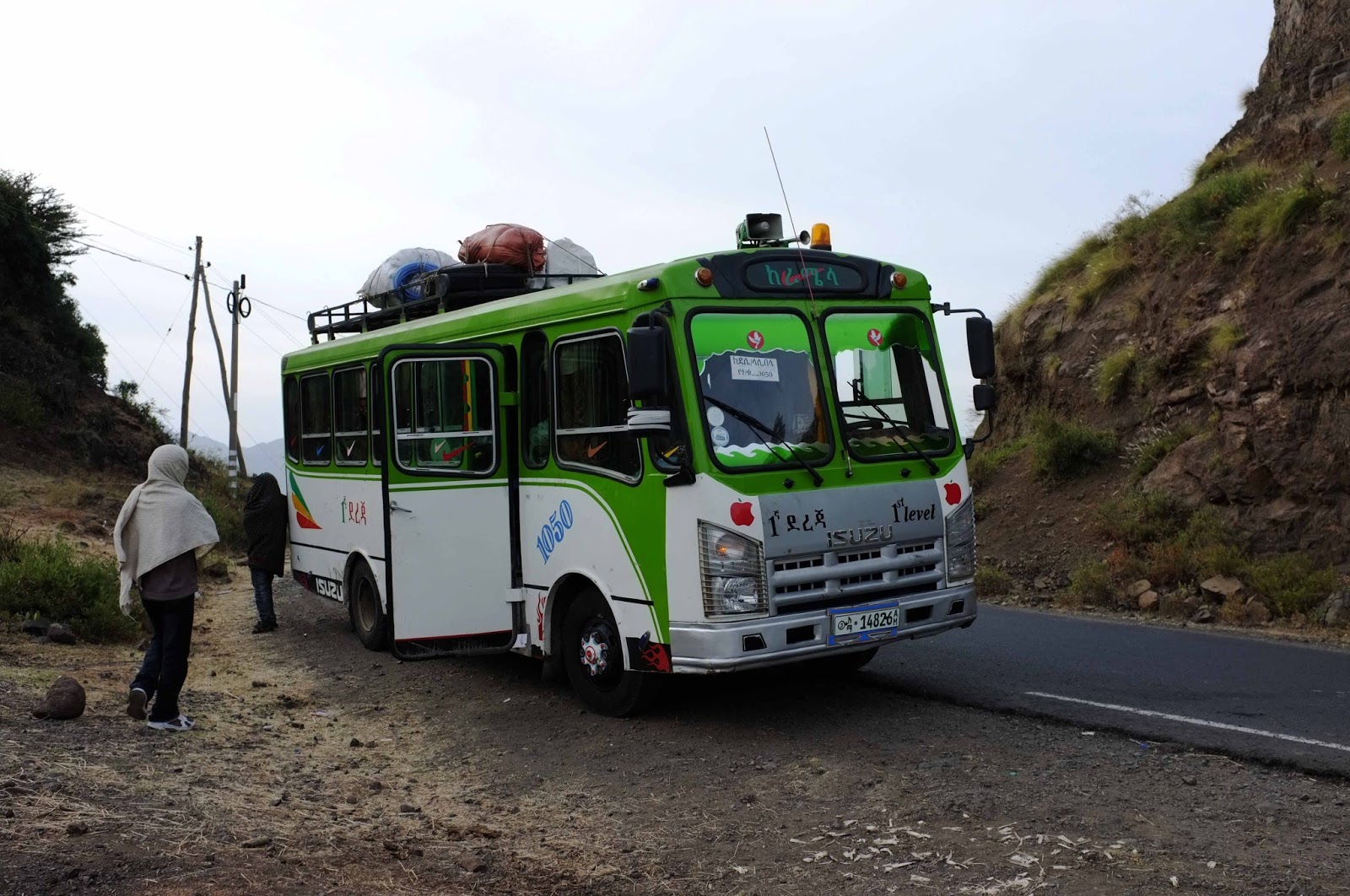
Long distance bus service was available but was it was quite an adventure in itself. The bus would start at Piazza in Addis Ababa at 06:00 a.m. The buses were quite rickety and had hard seats without cushions. Ethiopian habit of closing all windows meant stifling heat inside the buses. The buses would travel at their own pace and would reach Debre Markos by the evening.

Roads in Ethiopia were mostly gravel at that time and driving on them was tough in the day and impossible at night. There was no concept of national highways and it was quite risky to travel at nights. Travellers could be mauled by wild animals or attacked by desperate bandits who could be wielding deadly firearms. 
Wielding firearms was quite common in Ethiopia and most tribal men carry AK -47’s around quite nonchalantly. It was quite a sight to see skinny men wearing shorts, heft a Ak-47 as if it was stick.
Night halt at Debre Markos was mandatory and travellers had to shell out 10-20 birrs for a rudimentary lodging facility or shiver their way through-out the night in the cold bus. The bus would start the next day morning and reach Bahirdar by afternoon. The travel time from Addis Ababa was 36 hours for a distance of 650 kilometres!
The via media form of travel was taking a Cobra (Cobra is the Ethiopian name for a Toyota Land Cruiser). Ethiopians are quite enamoured by the Cobras and they are slavish in their devotion to the rugged vehicle. Cars are called Macena in Ethiopia and a single journey from Addis to Bahirdar costed 100 birr, back in 2002.

The beauty of traveling by the Cobra is that, travel time from Addis to Bahirdar could be cut by half. The Cobra would start from Addis in the morning and reach Bahirdar by night fall.

The first time I travelled by a Cobra was in February 2003. We were asked to come to a specified location in Kable 7 by 04:00 a.m. in the morning. Kable 7 was pitch dark and it was quite spooky to walk to the location. The location was a huge banyan tree from which many branches were swaying ominously and they seemed to mutter something! They looked like floating people and at that time it was quite natural to imagine supernatural and ghostly things that would have delighted the horror team of Ramsay brothers or Ram Gopal Verma!
I stood there feeling the nippy early morning air. I was wearing a woollen pullover but was drenched in sweat. Suddenly I realized there was something or somebody NEXT to me. I DARE NOT LOOK, AND I DARE NOT MISS LOOKING!

Mustering all the courage, I sneaked a look! I almost died. There were two people (did not know if they are men or women) completely wrapped in white cloth. Come to think of it, I did not even know if they were human beings! I am sure they were dead scared of the firanj too, standing all alone wearing a blue pullover! After a close inspection, I realized that they were a husband and wife pair and we exchanged greetings and smiles.

The Cobra was filled with 10 passengers and off we went. Travelling by a Cobra was like participating in a wild car rally. The metal roads were full of small rocks and that meant a bumpy ride. We were thrown up and down our seats and had to hold onto the side supports! Otherwise we would be falling on each other. Quite scary thought for travellers all huddled together like sardines in a tin box.   

Our Macena driver was driving at 100-120 kilometres and there was a dust trail following us like an unruly dog. Even though all the doors and windows were closed, fine dust came in and entered our mouth, nose and even ears. We had to wrap ourselves just like girl drivers wrap themselves on Indian roads, otherwise we could suffer from high levels of infection.  

If getting driven at high speed on the dusty Ethiopian roads was not enough the behaviour of the rural Ethiopian folks was even more scarier. The usually calm and placid rural folks would behave quite differently the minute they saw the Macena.
For the rural Ethiopians, life moved at a slow pace and their life was tranquil and unhurried. The fast moving and dust churning Macena was seen as the manifestation of evil. According to the folklore the rural Ethiopians considered the Macena to be evil and would jump right in front of the speeding car.
The innocent and naive villagers believed that they are pure at heart if they are saved by the alert driver who can swerve and save them. If they get hit by a speeding car the villagers felt that they are evil and deserved the punishment meted out by the speeding Macena. 

So often it was a cat and mouse game with the Macena drivers continuously on the lookout to avoid the villagers jumping in front of their cars and the villagers looking at every chance to jump in front of the car. Luckily for us we did not have any one jumping in front of our Cobra!

The next point of excitement was when we were crossing the Nile gorge. Nile gorge is a scene out of Makenna’s Gold movie. Our Macena cut through the mountain side and in front of us was the magnificent Nile gorge bridge. The car slowly crawled across the Nile gorge bridge. Watching us were hawk eyed military personnel. It was as if we were a part of a second world war movie.

Just like any other country, bridges could be sabotaged and if the Nile gorge bridge was sabotaged the only road link between north Ethiopia and the rest of the country would be gone. The military personnel carefully scanned through the car. No one was allowed to get off the car and woe beside anyone trying to take snaps.

The camera would be confiscated and in many cases the military personnel even refuse to give back the concerned camera. We were all tense but we passed the inspection and crossed the bridge. After that the journey was uneventful and soon we climbed down the mountain side and were met with the welcome sight of the twinkling lights of the New Flower – Addis Ababa. She was welcoming us into her warm bosom and we were elated that we made it to Addis Ababa safely and in one piece.

Sunday, December 24, 2017

10 - The Take off - Ethiopian Journey - Blog Post No - 10.


The day of the journey dawned finally. We went to Begumpet airport. The luggage was quite heavy and after all we were four people. We were given vegetable biryani by Dr. M. Uma. Being practicality personalised, she packed it in reusable containers!


We landed in Mumbai and immediately moved from the Domestic to the International terminus.  My children were unusually subdued. Pranav being a seven-year-old could understand but Sahithi was too small. We waited in the airport and it was interesting to see the tapestry of foreign visitors leaving India. There was a panorama of facial expressions on display. Some happy, some sad and some pensive.

I could make out many Indians also waiting like me. Then the check-in announcement was made and we finished all the formalities. Then the actual boarding started. There were many Indians and an equal number of Ethiopians. The Ethiopians appeared to be bemused at the number of Indians. But there were knowing nods and smiles. The Indian diaspora is well famed in the world for their ability to travel, adapt and make themselves comfortable in any country of the world. 

Edmund Hillary was the first man to climb Everest. He was bubbling with excitement and was overcome with the adrenaline rush. First man, First man he kept muttering to himself. “Enna sir, ninnalkk teyila venam?” Translated it means “sir, do you want tea?”. Flummoxed and flabbergasted he jerked around. It was a humble Malayalee, he not only reached mount Everest much before him, he started and was running a flourishing tea business! Even though said in jest, it is typical of the Indians’ urge to travel and make themselves name and fame in even the remotest parts of the world.

India has the world’s largest diaspora. Diaspora is the number of Citizens of a country living in other countries. Over 1.55 crore Indians live and work outside India, a number greater than the combined population of Zimbabwe and Kuwait. Mexico has a Diaspora of 1.23 crores and Russia has a diaspora of 1.06 crores. Truly amazing!


We were flying Ethiopian airlines. We were warmly greeted by the Ethiopian air hostess. Standing next to her and wearing a beautiful Ethiopian dress was another girl. Both of them were strikingly beautiful. They did not look like the typical Africans that we see in the popular media.


We were seated and one of the air hostess came and said “fasting or non-fasting”. I was taken back ‘what does she mean?’. Understanding my confusion, she corrected herself “Vegetarian or non-vegetarian meals?”. I told her three non-vegetarian meals and one Vegetarian meal. An Ethiopian sitting next to me explained “Ethiopians love meat and meat products. So not eating meat products and having only vegetables and Injira (Ethiopian staple food) is allowed during fasting time. So all vegetarian food in Ethiopia is called fasting food”. I don’t know how the vegetarians would react! If veg food is fasting food, what is Vegan food? starving food! Your guess is as good as mine.


The Airplane was a wide bodied 787. Very spacious and very wide. I could make out a smattering of kids, most of them Ethiopians. It was a five-hour journey and we started making friends. A young man, Mr. Bala Krishna came up and introduced himself. Bala said “Sir, this is a very big contingent of Indian teachers. We are as many as 78 (including spouses and children). With you there are ten from Andhra Pradesh. Four from your family, me and my wife, Dr. Srinivas Inguva, Dr. T. N. Murthy, Mrs. Tasleem and her daughter”. I was thunder struck at his networking ability and ability to get data. “This man would be a great researcher” I told myself. 


He also told me that he belongs to POLY (the engineering division of BDU) and that the rest of us will be reporting to PEDA (Pedagogy Academy, the division for all other departments excluding engineering). I thought PEDA was a quite an interesting name, It means a sweet in Northern India!


Mr. Bala Krishna was a teacher from the Electrical department, Me and Dr. T. N. Murthy from the Management department, Dr. Srinivas Inguva was from the accounting department and Mrs. Tasneem was from the Law department. The five-hour journey was over in a jiffy and before we knew we were taxing down on the run way of Addis Ababa. We have arrived!!!